What is CBT?
Understanding Cognitive Behavioral Therapy (CBT)
Psychotherapy has become increasingly sought out in recent years as people have gained less stigmatized information about mental health and look for ways to improve their well-being. It’s important to make an informed choice about a therapy type (and therapist) that might be right for you.
One of the most established and widely practiced therapies for mental health concerns is Cognitive Behavioral Therapy (CBT). But what is CBT, and how does it work?
What is CBT?
CBT stands for for Cognitive Behavioural Therapy.
CBT is a type of psychotherapy that focuses on the connection between our thoughts (cognitions), feelings, and actions (behaviours) to alleviate mental health concerns. Psychotherapy, commonly called talk therapy, is a type of treatment that aims to improve emotional, mental health, and/or behavioural concerns. Different psychotherapies emphasize differing mechanisms of change and CBT is no different.
“Talk therapy” is named so because it does not involve medical interventions such as medicine however the term is a bit of a misnomer when it comes to CBT because CBT emphasizes practicing skills and taking action.
Research has demonstrated that CBT is an evidence-based treatment for many mental health challenges including depression, bipolar disorder, panic attacks, social anxiety, phobias, post-partum challenges, psychosis and many more.
The CBT Model
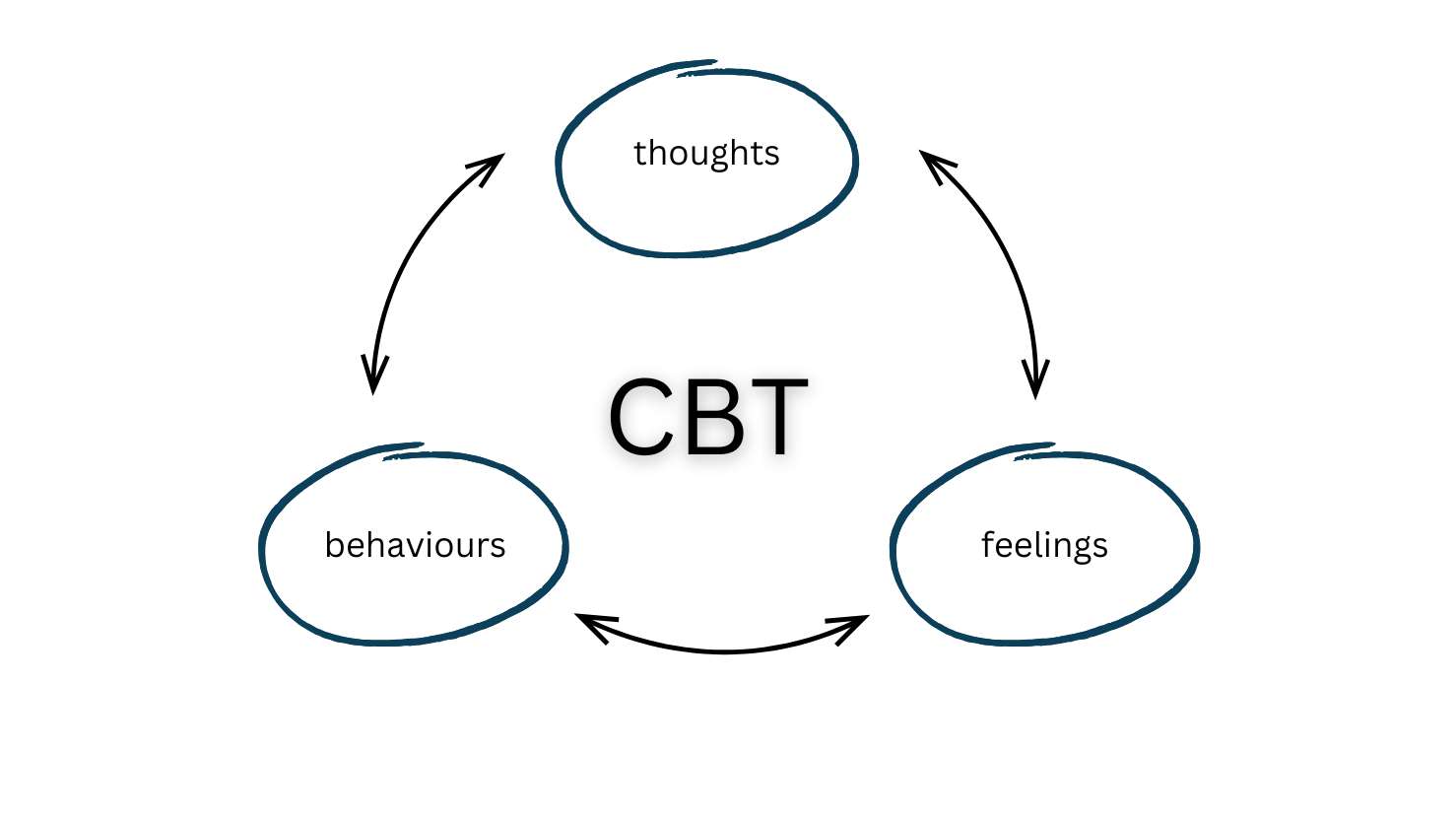
CBT operates on the premise that our thoughts (cognitions), particularly negative or unhelpful ones, influence how we feel and act. In other words, how we think about a situation shapes how we respond to it emotionally and behaviorally. In it’s most simplistic form, the CBT model looks like this:

The CBT model also emphasizes the importance of behaviours and shows us how unhelpful behaviours reinforce unhelpful thoughts and perpetuate painful emotions. This then feeds into more unhelpful behaviours and thoughts and more suffering. People often recognize this as “spiraling” and that’s because each of those arrows in the diagram above are actually bi-directional and look something like this:

CBT is an Umbrella Term
CBT is best understood as an umbrella term for a set of therapeutic modalities and techniques that share an underlying theory: thoughts and behaviors maintain unwanted mental health challenges. Indeed, many therapy types have been born out of a CBT foundation.
Some examples of CBT-based psychotherapies include Dialectical Behaviour Therapy (DBT), Cognitive Processing Therapy (CPT), Compassion-Focused Therapy, Acceptance and Commitment Therapy (ACT), Exposure and Response Prevention (ERP), and Mindfulness-Based Cognitive Therapy (MBCT), amongst many, many others.

How Does CBT Work?
Now that we know what CBT is, the next natural questions may be: “how does CBT work” or “how can CBT help me?”
CBT works by helping clients identify and change unhelpful thinking patterns and behaviours to improve mental health and overall well-being. By recognizing the link between thoughts, feelings, and behaviors, we can learn to ultimately replace unhelpful thinking and behaviours with more constructive and helpful ones.
CBT ultimately works by slowing down or even stopping the cycle of spiraling. Together, cognitive and behavioural changes alleviate emotional difficulties like depression and anxiety.
CBT works by doing something like this:

Of course, learning to replace unhelpful thinking and engage in more adaptive behaviours takes practice and, often, the support of a therapist. It is important that you work with a therapist that you have established a good relationship with. A therapist well-versed in CBT will help clients build key skills.
Key Skills Learned in CBT
CBT works by helping individuals break the cycle of unhelpful thoughts, behaviours, and feelings. Here are some key techniques that are often used in CBT:
- Increased Self-Awareness: CBT teaches folks to better understand what is upsetting and triggering them about any given situation. It helps people answer the question, “why is this troubling me?”
- Identifying Unhelpful Thinking: CBT therapists help clients identify unhelpful thinking patterns. We all engage in these types of thinking. For example, some of us might catastrophize a situation when we expect the worst case scenario. We might engage in mind reading when we arbitrarily guess at what someone will think of us. Or, we might discount what we did well when we dwell on a mistake. All of these thinking patterns are considered unhelpful because they make us feel bad and don’t necessarily reflect the situation in a balanced manner.
- Cognitive Restructuring: Cognitive restructuring is the process by which therapists teach clients to use the unhelpful thoughts they identified, challenge them, and create alternative, more balanced thoughts. For example, someone who has the thought “I’ll never get a job” might be guided to reframe this thought into “I’ve landed a job before and while it might take time, I have skills and experience to find a job.”
- Behavioural Change: The type of behavioural change that a therapist will work on with a client will depend on what a client is seeking support with. Some common behavioural skills include:
- Behavioural Activation: For those looking to alleviate depression, behavioral activation involves working with clients to engage them in activities that will improve their mood.
- Exposure Therapy: This technique is often used to treat anxiety disorders, like phobias, anxiety disorders, and OCD. The person gradually confronts their feared situation in a controlled, safe manner, and with the support of their therapist. With repeated behavioural exposures, fear lessens.
- Other skills: CBT approaches will often incorporate other skills to support folks seeking change. This can include relaxation strategies, grounding exercises, and mindfulness techniques. All of these skills support coping in difficult situations.
What are the Waves of CBT?
Since it’s inception in the 1940s, CBT is considered to have undergone multiple “waves” of changes. The waves refer to significant evolutions within the understanding of what causes mental health concerns and thereby the practice of CBT.
The first wave of CBT focused on changing behaviours through associations. For example, by pairing wanted outcomes with rewards and unwanted outcomes with unwanted experiences (i.e., classical conditioning). This wave of CBT placed a heavier emphasis on behaviourism or the ‘B’ in CBT.
The second wave of CBT placed a greater emphasis on thoughts than the first wave of CBT. It is based om Aaron Beck’s cognitive therapy and emphasizes recognizing and changing unhelpful thinking patterns. Behavioural change remains important here but there were new developments surrounding how those changes can occur (for example, by changing and challenging unhelpful or untrue thoughts).
Finally, the third wave of CBT takes a more holistic approach to psychotherapy and wellness. For example, matters like quality of life beyond the absence of troubling symptoms is emphasized. This includes guiding clients to identify and live according to their values; engage in meaningful, restorative relationships; and relate and speak to themselves in less critical ways.
Does CBT work?
Yes, CBT works! Not only that, but it is very effective. Numerous studies have shown that CBT is an effective treatment for a wide range of mental health issues, including anxiety, depression, obsessive-compulsive disorder (OCD), post-traumatic stress disorder (PTSD), addiction, insomnia, and many more mental health concerns. As such, CBT is an evidence-based treatment for many mental health concerns.
One of the reasons CBT is so effective is that it provides individuals with practical tools and strategies to manage their thoughts, feelings, and behaviours and empowers them to use these skills even when they are not actively engaging in psychotherapy.
An attractive feature of CBT is that it is a relatively short-term therapy, often lasting between 8 to 20 sessions, particularly for isolated concerns. Of course, for people who prefer the support of longer-term therapy or have multiple (sometimes called co-morbid) concerns, CBT can be adapted or integrated with other therapy types.
CBT can be conducted one-on-one with a therapist, in a group setting, and through online platforms. Research has shown that CBT is effective in all these various forms and settings.

Summary: What is CBT?
Cognitive Behavioral Therapy, or CBT, is an effective psychotherapy for folks looking to manage their mental health and break free from negative thought patterns and/or behaviours. Whether someone is dealing with anxiety, depression, trauma or they simply want to improve their emotional well-being, CBT offers practical, evidence-based techniques that can make a significant difference in their life. By learning how to identify and challenge unhelpful thoughts, one can create lasting positive changes in how they feel and behave.
If you think CBT might be right for you, consider reaching out to one of our licensed therapists: we all practice this approach and are happy to support you in taking a step toward a healthier, happier mindset and a future.
Disclaimer: The information provided above is for informational purposes only. It is not professional psychological advice, a recommendation or endorsement of program/service, nor is it intended to be a substitute thereof. The information shared was deemed accurate at the time of publication, however, this blog is not regularly updated and therefore information may be dated and may not reflect the more current and accurate information over time.